русский
 Español
 Français
Industry News
1
Why Film Applied Normally Can Start Peeling After Standing
Film performance is not fully determined at the moment of application completion. From spraying onto the substrate through solvent evaporation, resin film formation, and final film development, the process involves continuous change. If the bond between substrate and coating is not sufficiently stable, or the film has significant shrinkage stress, no obvious abnormality may be visible right after application — but after standing, friction, or external force, the problem gradually manifests.
2
Substrate Surface Condition — Don't Rush to Change the Coating
Whether coating can adhere firmly, substrate surface state is an important factor. Metal, plastic, and glass substrates have different surface properties, and the same material after different processing may differ. If oil contamination, release agent, or dust remain on the substrate, the actual contact between coating and substrate is compromised. For PP, PE, and other low-surface-energy plastics, this is especially pronounced — coating may cover the surface without forming ideal interfacial bonding.
3
Insufficient Coating Wetting of the Substrate May Also Be a Peeling Starting Point
After coating reaches the substrate surface, it needs to spread and wet. If the coating's spreading state on the substrate is poor, locally insufficient contact zones may form. These positions more readily develop film delamination when subjected to friction, bending, or other external force. At this point, the wetting system is worth checking — but wetting agents and adhesion promoters serve different functions and addressing the wrong problem produces no result.
4
Adhesion Promoter Is Not a Universal Solution — Matching Is Key
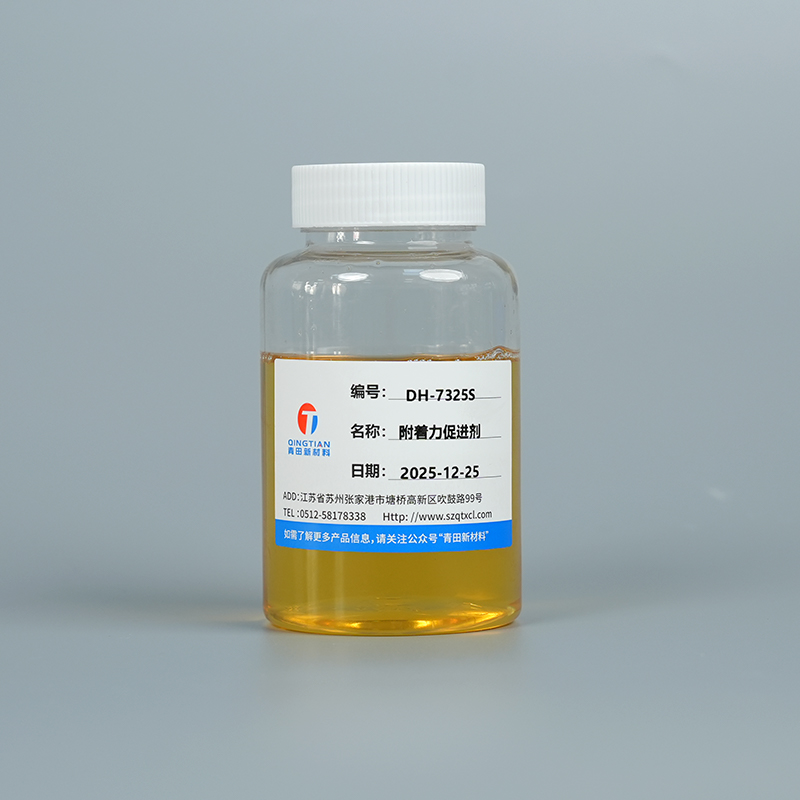
Adhesion promoter is one important adjustment direction in the adhesion system, but it does not apply equally to all substrates. Different plastic, metal, and glass substrates have different surface properties; different resin systems differ in polarity, flexibility, and film formation. Therefore, when selecting an adhesion promoter, what deserves more attention is its matching with the substrate and resin — not simply assuming that more addition solves the problem.
5
Why Does More Adhesion Promoter Still Leave Peeling?
When adhesion problems appear, many formulations first increase adhesion promoter proportion. But if the true problem comes from substrate contamination, surface state, or film formation conditions, the action space for simply increasing adhesion promoter is limited. Additionally, changing additive dosage may affect coating compatibility, film state, and other application performance — so adhesion promoter is better used through gradient testing to find the appropriate range, rather than continuously increasing.
6
Film Internal Failure Can Also Be Mistaken for Poor Adhesion
Not all "peeling" is an interface problem. If the film's own cohesive strength is insufficient and it is subjected to external force, the film may fail internally. At this point even if substrate-coating bonding is fine, cracking and flaking may still appear. Observing the failure location after testing helps distinguish: film peeling cleanly from the substrate points to substrate treatment and interfacial bonding; substrate retaining some residual film while the film itself breaks points to the resin system and film formation state.
7
Why Lab Adhesion Good, Production Still Peels?
Lab test panels and actual products may have different application conditions. In actual production, spray film thickness, flash-off time, baking temperature, baking time, and substrate state may all affect the final film. Especially for plastic parts that may undergo bending, impact, and friction in actual use — if lab testing only performs a single adhesion test without simulating actual use conditions, test results may not predict production performance.
8
Film Peeling: Systematic Troubleshooting Sequence
Substrate state → surface cleaning → surface treatment → coating wetting → resin system → adhesion promoter → film thickness → drying conditions. First determine which layer the problem occurs in, then address that specific stage. For example: substrate contamination → treat the substrate first; insufficient coating spreading → check the wetting system; insufficient interfacial bonding → further screen adhesion promoters; film itself failing → return to resin and film formation analysis.
Summary
Film peeling may involve substrate, wetting, resin, adhesion promoter, and application process across multiple stages. Adhesion promoter can be an important adjustment tool, but cannot replace substrate treatment and a reasonable coating formulation. In actual application, the film peeling location should be identified first, then the appropriate adjustment direction chosen based on substrate and resin system. Analysing substrate state, interfacial bonding, film formation, and application conditions together makes it easier to find a solution suited to the specific coating system.
Frequently Asked Questions
Is there a reliable way to distinguish interface failure from cohesive failure without expensive equipment?
A simple peel test observation provides a reliable indication: after tape peel or cross-cut testing, examine the tape and the substrate surface together. If the tape removes the film cleanly (tape shows a complete ink/film transfer, substrate is clean), this is interface failure — the bond between coating and substrate broke. If the tape shows partial film transfer and the substrate also retains some coating material, this is cohesive failure — the film broke internally. This distinction, made immediately after the test, reliably directs the investigation toward the correct variable without instrumentation.
Can an adhesion promoter improve adhesion to both metal and plastic substrates in the same formulation?
Adhesion promoters are typically selective in their substrate affinity. Silane coupling agents are effective for glass, silica, and metal oxide surfaces; CPO-based promoters are effective for polyolefin surfaces; titanate-based promoters have broader metal and mineral substrate affinity. A single adhesion promoter is unlikely to simultaneously optimise adhesion to both a metal substrate and a polyolefin plastic substrate. For multi-substrate applications, evaluation of each substrate separately to identify the appropriate promoter type for each is the correct approach.