русский
 Español
 Français
Industry News
Adhesion | Flexible Coating
In flexible substrate coating systems — synthetic leather, flexible packaging, metal coil stock, and electronic films — passing adhesion testing is only half the story. Real-world bending and flexing can still cause delamination, cracking, and peeling.
Adhesion tests measure initial interfacial bond strength under static, undisturbed conditions. They do not simulate sustained bending stress, repeated deformation cycles, or the differential strain that occurs between coating and substrate during real-world use. Understanding the gap between adhesion data and flexible durability is critical for anyone formulating coatings for flexible substrates.
Static Adhesion vs. Dynamic Flexibility — Two Different Properties
What Adhesion Tests Tell You
- Cross-cut test passes — coating bonds well
- Pull-off value meets specification
- Surface appearance is normal
- No visible defects at time of measurement
What They Don't Tell You
- Behavior under repeated flexing cycles
- Deformation compatibility with substrate
- Response to sustained tensile/compressive stress
- Long-term fatigue resistance at the interface
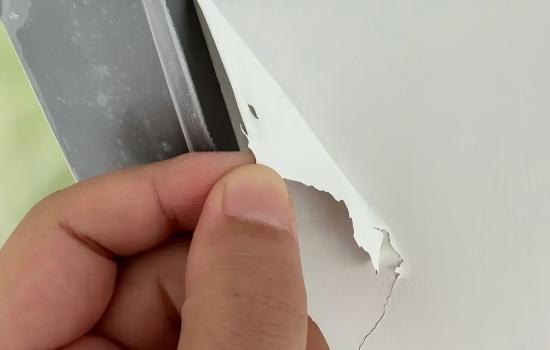
Six Root Causes of Post-Bend Delamination
Cause 01
Bending Generates Sustained Interfacial Stress
When a coated material bends, the outer surface is in tension while the inner is in compression. Shear stress concentrates at the coating-substrate interface. Once this stress exceeds the interfacial bond capacity, delamination begins — even if initial adhesion was acceptable.
Cause 02
Coating and Substrate Have Different Deformation Behaviors
Flexible substrates (TPU, PVC, PET film, aluminum foil) are highly extensible. Rigid or semi-rigid coatings cannot match this deformation. The resulting strain mismatch creates peel forces at the interface during every flex cycle.
Cause 03
Residual Internal Stress Is Amplified by Bending
During curing, coatings develop residual stresses from solvent evaporation and crosslink shrinkage. These stresses are invisible in static testing but are amplified under bending — providing additional force that initiates delamination.
Cause 04
Micro-Defects Propagate Under Repeated Stress
Imperfect substrate wetting, micro-pores, or uneven interface regions that cause no measurable adhesion loss in single testing become crack initiation points under cyclic bending. Each flex cycle expands these defects progressively.
Cause 05
Environmental Aging Weakens the Interface Over Time
High humidity, thermal cycling, and UV exposure degrade interfacial bond strength progressively. A coating that holds in day-one testing may lose critical interfacial strength after weeks in service — making it vulnerable to delamination during normal use.
Cause 06
Testing Captures a Single Moment, Not Service Life
At the point of testing, the coating has not yet experienced mechanical stress. Internal defects have not expanded. Residual stress has not been released. Time under load reveals the true durability of any coating system.
A More Complete Evaluation Framework for Flexible Coatings
| Test Method | What It Measures | Why It Matters |
| Mandrel Bend Test | Minimum bend radius without cracking | Directly simulates real-world flex conditions |
| T-Peel / 180° Peel | Peel resistance under deformation | Quantifies interfacial strength under peel stress |
| Thermal Cycling | Adhesion retention after temperature variation | Simulates outdoor or industrial use environments |
| Film Modulus / Elongation | Flexibility and extensibility of the cured film | Predicts CTE mismatch risk with substrate |
| Cyclic Flexing Test | Adhesion and film integrity after repeated bending | Identifies fatigue failure modes invisible in static tests |
Design Principle for Flexible Substrate Coatings
Adhesion and flexibility are two distinct and complementary properties. A coating formulation for flexible substrates must be designed with sufficient elongation-at-break, controlled crosslink density, and interfacial compatibility to sustain its bond through real-world bending and environmental cycling — not just meet static test specifications at point of application.
Key Takeaway
When a coating delaminates after bending despite passing adhesion tests, the failure is rooted in a mismatch between interfacial bond strength and deformation capability. Solving it requires evaluating flexibility, internal stress, substrate compatibility, and long-term interfacial stability — not just the initial adhesion number. Suzhou Qingtian New Materials supplies adhesion promoters and resin systems optimized for flexible coating applications.
Developing Coatings for Flexible Substrates?
Our technical team provides formulation consultation and specialty additives for flexible coating systems.