


 русский
 Español
 Français
Home / News / Industry News / Pigment Was Ground Very Fine — Why Does the Paint Still Show Flooding and Colour Mottle?
Industry News

In oil paint and ink production, flooding and colour mottle are common appearance problems. Some formulations look normal in colour right after tinting, but after storage, application, or drying, the film develops uneven colour depth and localised colour shift. When this happens, many people check grinding fineness and may even extend grinding time. But the actual situation is not always about grinding.
Whether pigment can be ground fine and whether it can maintain stable dispersion after grinding are two different questions.
Grinding primarily helps pigment agglomerates break down, bringing particles to a finer state. But after grinding, if particles still easily re-approach and aggregate, the dispersion state may change during storage. Freshly produced state looking fine but developing particles, settling, or re-coarsening after standing — this is the typical pattern of inadequate dispersed state stability rather than inadequate grinding.
Titanium dioxide, organic colour pigments, and inorganic pigments differ in particle size, surface properties, and wetting requirements. The same dispersant acting on different pigments may produce quite different results. When one pigment is in a relatively stable state while another is not, as the film forms, colour distribution may gradually develop changes — some pigments migrating toward the film surface layer or other areas.
During film drying, the resin and solvent continuously change. As solvent evaporates, internal film flow gradually reduces — pigment particles also go through a rearrangement process. If different pigments have large mobility differences, some may migrate toward the film surface layer or other zones — forming flooding, colour mottle, or uneven depth.
The same dispersion system performing normally in a single-pigment formulation does not mean it is equally appropriate in a multi-pigment tinted formulation. When titanium dioxide and multiple colour pigments coexist, inter-pigment interactions increase and the formulation's demands on dispersion state also increase accordingly.
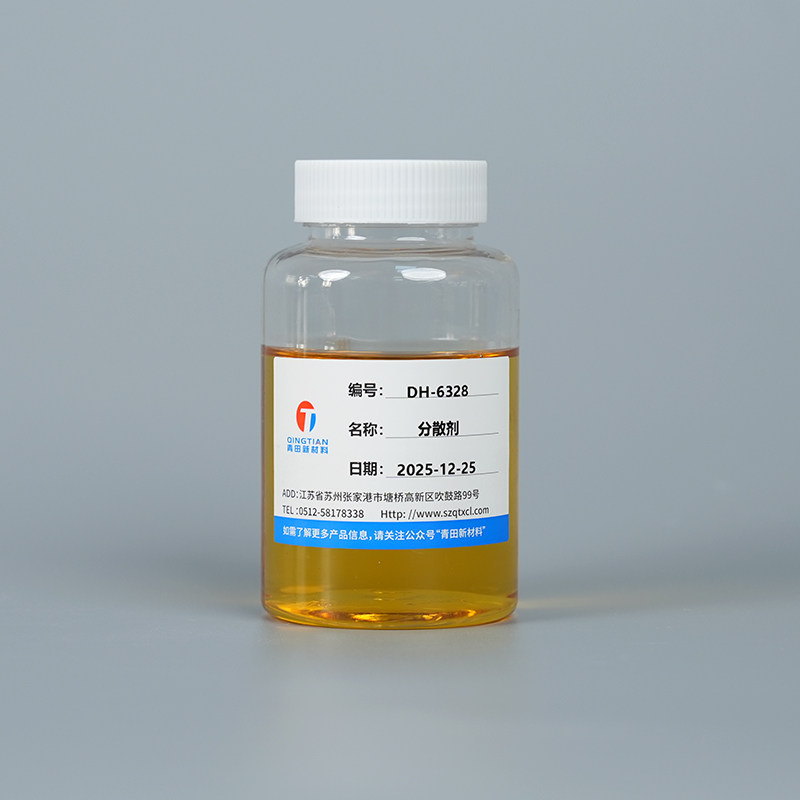
DH-5104 is an anti-flooding dispersant for oil-based coating and ink systems, suitable for tinting systems using titanium dioxide alongside other organic and inorganic pigments. In use, DH-5104 can be added to the grinding base resin first, then the pigment grinding process carried out — allowing the additive to participate in pigment wetting at the grinding stage. Post-addition testing is also possible. Reference addition ranges: organic pigments 2%–5%; inorganic pigments 0.5%–3%; post-addition 0.1%–1.5%. Applicable systems: alkyd, polyester, polyurethane, epoxy, and acrylic solventborne coatings and ink systems.
In practical use, gradient testing for each different pigment rather than using a fixed ratio is recommended. For titanium dioxide and organic colour pigment combinations, observing grinding fineness, state after storage, film colour uniformity, and post-drying flooding changes separately makes it easier to determine the appropriate addition level.
Oil paint flooding and colour mottle cannot simply be attributed to "pigment not ground fine enough." What truly affects storage and film formation state is the dispersant's stabilisation of pigment surface dispersion, and the matching between dispersant, pigment, and resin. Particularly in multi-pigment formulations with titanium dioxide, dispersion balance between different pigments is especially worth attention. Gradient testing and combining storage state and film appearance evaluation gives a more complete picture than fineness alone.
 Wholesale Paint/ Coating Additives Manufacturers
Custom Industrial Chemical Solutions Suppliers
Wholesale Paint/ Coating Additives Manufacturers
Custom Industrial Chemical Solutions Suppliers