


 русский
 Español
 Français
Home / News / Industry News / Why Do Solventborne Coatings and Inks Develop Flooding and Colour Mottle? The Problem Is Pigment Dispersion Stability
Industry News

In solventborne coating and ink production, flooding and colour mottle are common and recurring appearance problems. When grinding has just been completed, the colour paste may look very uniform — but after thinning, application, and drying, the film surface shows colour inconsistency, local hue changes, and similar phenomena. This type of problem does not necessarily mean the pigment grinding was insufficient. In some cases, even when the pigment has been ground to a fine state, different pigments can still migrate and redistribute during the film drying process due to differences in wetting state, density, and interfacial interaction. Therefore, solving flooding and colour mottle cannot focus only on the grinding stage — the stable state of the pigment after entering the film must also be addressed.
Different pigments have different surface properties, and may show different wetting and dispersion states in the same system — ultimately causing non-uniform film colour.
After coating application, as solvent evaporates and the film flows, pigment particles readjust their positions. If system stability is insufficient, localised pigment enrichment may form.
Extended grinding primarily resolves pigment agglomeration, but if the root cause of flooding is dispersion stability differences between different pigments, more grinding cannot fundamentally solve it.
If the dispersion system cannot maintain a stable state during long-term pigment storage, gradual settling and caking phenomena may appear, further affecting subsequent application and colour consistency.
Pigment dispersion is not simply a matter of grinding large particles into small particles. In a coating system, pigment particles after grinding need dispersant and other components to form a stable protection state on their surface, keeping particles at a certain distance and reducing the possibility of re-agglomeration.
When a formulation contains multiple pigments, the surface properties of the various particles are not completely identical. If certain pigments are more easily wetted by the system, or if the degree of dispersion stability differs between different pigments, migration and redistribution may occur during the film drying process. Therefore, flooding and colour mottle sometimes do not mean "dispersion was inadequate" — they mean "the dispersion state is not stable enough." This is also why some formulations, even when grinding fineness is very good, still show unsatisfactory colour performance after drying.
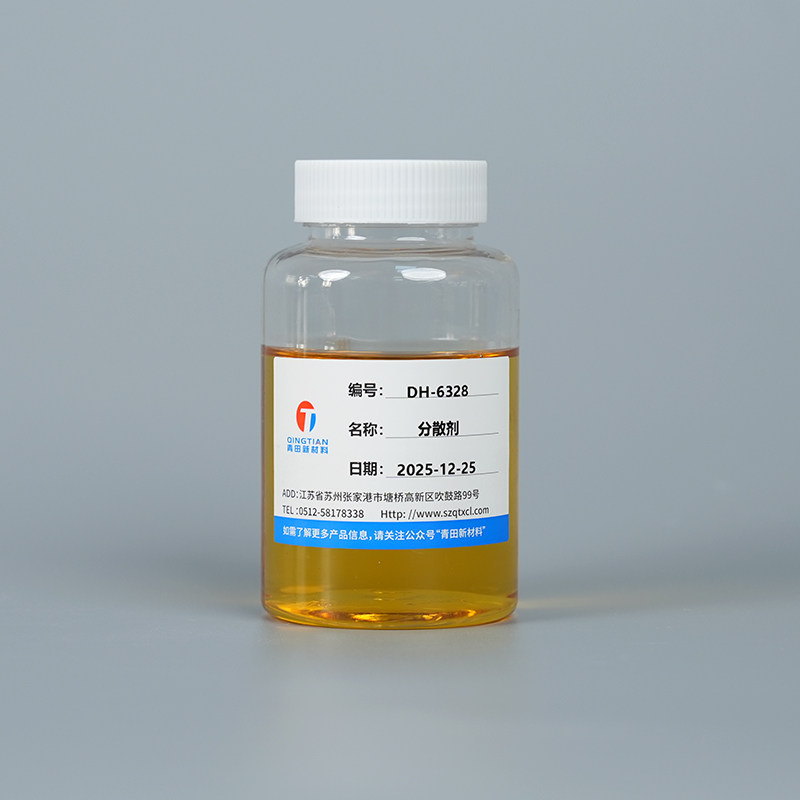
DH-5104 is an anti-flooding dispersant additive for use in solventborne coating and ink systems, primarily addressing flooding, colour mottle, and insufficient dispersion stability that easily occur when multiple pigments coexist. Its approach is not simply to improve pigment grinding efficiency, but to improve the wetting and stable dispersion state of pigments in the system, thereby reducing the redistribution of different pigments during storage and film formation. For inorganic pigments and fillers, the product can help improve their dispersion stability and reduce the possibility of settling and caking during long-term storage.
Applicable systems include alkyd, polyester, polyurethane, epoxy, and acrylic solventborne coatings and ink systems. In use, DH-5104 can be added to the grinding base resin first, then the pigment grinding process carried out; or it can be post-added according to the actual formulation conditions. Reference dosage can be adjusted according to pigment type: organic pigments typically 2%–5%, inorganic pigments approximately 0.5%–3%; for post-addition, a range of 0.1%–1.5% of total formulation can be tested, optimising the addition ratio based on the actual degree of flooding and colour mottle.
Flooding and colour mottle do not necessarily mean insufficient pigment grinding — what truly needs attention is the stable dispersion state of different pigments in the entire coating system. Particularly in multi-pigment formulations, only by maintaining a relatively uniform and stable dispersion state of the pigments can the possibility of redistribution during storage and film formation be reduced. Therefore, when solving flooding problems, in addition to adjusting grinding processes, the matching relationship between the dispersant and pigments should also be the starting point.
 Wholesale Paint/ Coating Additives Manufacturers
Custom Industrial Chemical Solutions Suppliers
Wholesale Paint/ Coating Additives Manufacturers
Custom Industrial Chemical Solutions Suppliers