


 русский
 Español
 Français
Home / News / Industry News / Why Your Coating Film Keeps Cratering — and What Substrate Wetting Has to Do With It
Industry News

Small circular depressions form in the wet film and remain visible after cure, disrupting surface uniformity and the overall finish.
The coating fails to spread evenly across the substrate, leaving thinner or thicker zones that affect both appearance and protective performance.
Multi-coat applications show inconsistent results from one coat to the next, making it hard to predict how the final build will look.
Switching from one substrate to another — plastic to metal, or metal to glass — changes application behavior even when the formulation stays the same.
Adding more thinner or adjusting spray/application parameters is often the first response to cratering or poor spreading, and it can sometimes mask the issue locally. But because different substrates have inherently different surface characteristics, process adjustments alone rarely deliver consistent wetting, flow, and recoat performance across plastic, metal, glass, and wood at the same time — the additive system needs to address the interface itself.
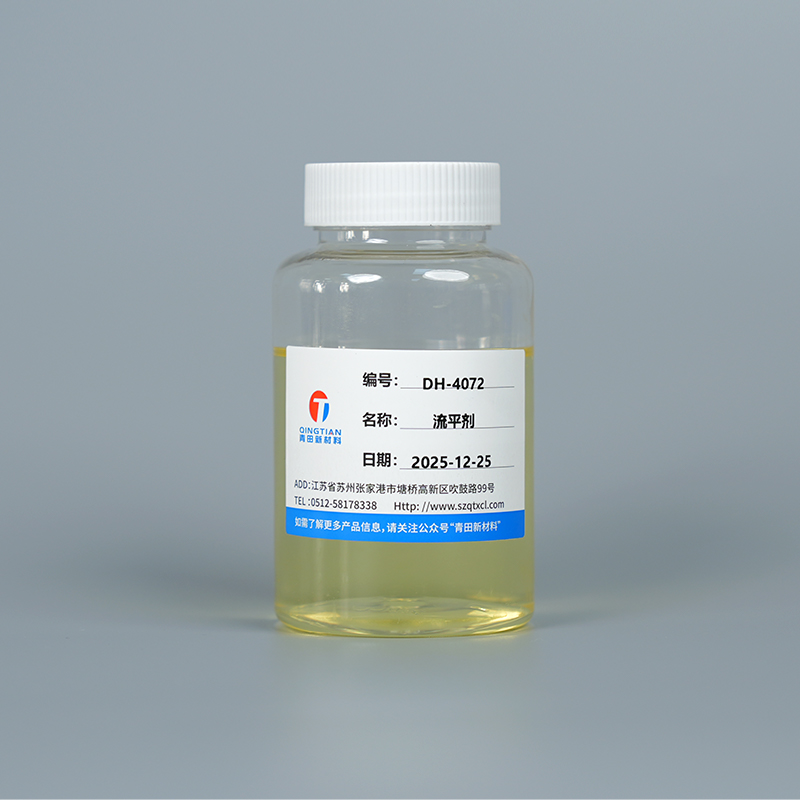
DH-4072 is a substrate wetting agent designed to improve how a coating spreads across the substrate surface, helping the system form a more uniform film and reducing the occurrence of cratering and related surface defects. It promotes flow while maintaining good recoat compatibility, so multi-coat applications remain stable from one pass to the next.
| Substrate Wetting | Improves how the liquid coating spreads across the substrate surface during application |
| Cratering Reduction | Helps reduce the occurrence of small circular depressions in the cured film |
| Flow Promotion | Supports uniform film formation across the applied area |
| Recoat Compatibility | Maintains good adaptability for multi-coat builds without disrupting interlayer performance |
| Interface Optimization | Optimizes the wetting state at the liquid-substrate interface, supporting a smoother, finer surface |
| Substrate / System | 2K Waterborne | Solventborne | UV Curing |
| Plastic | Good | Good | Good |
| Metal | Good | Good | Good |
| Glass | Good | Good | Good |
| Wood | Good | Good | Good |
Does DH-4072 only address cratering, or does it also improve general appearance?
While cratering reduction is one of its primary benefits, improved substrate wetting also supports more uniform spreading and a finer overall surface, which can improve general appearance beyond just eliminating craters.
Can it be used across a multi-substrate production line?
Yes — its compatibility profile covers plastic, metal, glass, and wood substrates, which makes it suitable for evaluation in production environments handling multiple substrate types.
Is it suitable for both single-coat and multi-coat systems?
Its recoat compatibility makes it suitable for multi-coat builds, while its wetting and flow benefits are also applicable to single-coat applications.
Which curing systems is it compatible with?
DH-4072 has been evaluated across two-component waterborne systems, solventborne systems, and UV-curing formulations.
Cratering and uneven spreading are usually wetting issues at the substrate interface, and they often vary by substrate type — which is why a single process adjustment rarely fixes them everywhere.
Struggling with cratering, uneven spreading, or inconsistent recoat results across different substrates? Request technical information on DH-4072 substrate wetting agent.
Request Technical Information
 Wholesale Paint/ Coating Additives Manufacturers
Custom Industrial Chemical Solutions Suppliers
Wholesale Paint/ Coating Additives Manufacturers
Custom Industrial Chemical Solutions Suppliers