русский
 Español
 Français
Industry News
Polypropylene (PP) and polyethylene (PE) are among the most widely used plastics in automotive trim, consumer goods, and industrial components — and among the most difficult to coat. Direct spray application onto untreated PP or PE surfaces routinely produces poor adhesion, premature paint flaking, and inadequate water resistance. The reason is fundamental to the chemistry of these polymers, and no amount of formulation adjustment in the topcoat alone can fully compensate for it.
The Low Surface Energy Problem
PP, PE, POM, and EPDM rubber share a common characteristic: low surface energy. Their molecular structure provides few sites for a coating to chemically or physically anchor to, and their non-polar nature means most coating systems — formulated around polar resin chemistry — cannot achieve adequate wetting or interfacial bonding without surface modification. This is a substrate property, not a coating formulation deficiency, which is why adjusting the topcoat alone rarely solves the underlying adhesion problem.
Common Failure Patterns on Low-Energy Substrates
| Failure Type | Typical Cause | Conditions Where It Appears |
| Immediate Flaking or Peeling | Coating never achieved adequate wetting or anchoring on the substrate surface | Visible shortly after application or during handling |
| Delayed Adhesion Failure | Marginal initial adhesion that deteriorates under mechanical stress or thermal cycling | Appears during product use, weeks to months after coating |
| Boiling Water / Humidity Failure | Moisture penetrates the weak interface and undermines adhesion from beneath the coating | High-temperature, high-humidity testing or tropical climate use |
| Shrinkage-Related Distortion | Uneven surface treatment leads to inconsistent film formation and internal stress | Complex geometries with variable surface treatment uniformity |
| Difficulty on Specialty Substrates | Rubber (EPDM) and stainless steel present additional surface chemistry challenges beyond standard plastics | Mixed-material assemblies and multi-substrate components |
Why Physical Surface Treatment Methods Have Practical Limits
Flame treatment, corona treatment, and mechanical abrasion are established methods for increasing substrate surface energy, and each has a place in production. However, all three share practical limitations that make them difficult to rely on as a sole solution, particularly at scale:
Physical Treatment Methods
- Performance highly dependent on equipment calibration and condition
- Treatment uniformity difficult to maintain on complex 3D geometries
- Effectiveness can decay between treatment and coating application
- Limited applicability to rubber and certain metal substrates
- Process consistency challenging in high-volume production
Chemical Substrate Treatment
- Consistent surface modification independent of part geometry
- Applicable across PP, PE, POM, EPDM, and selected metal substrates
- Compatible with downstream PU, thermoplastic coating, and vacuum plating processes
- Process integrates into standard spray or dip application equipment
- More predictable batch-to-batch performance at scale
DH-7208 — Substrate Treatment Agent for Low-Energy Materials
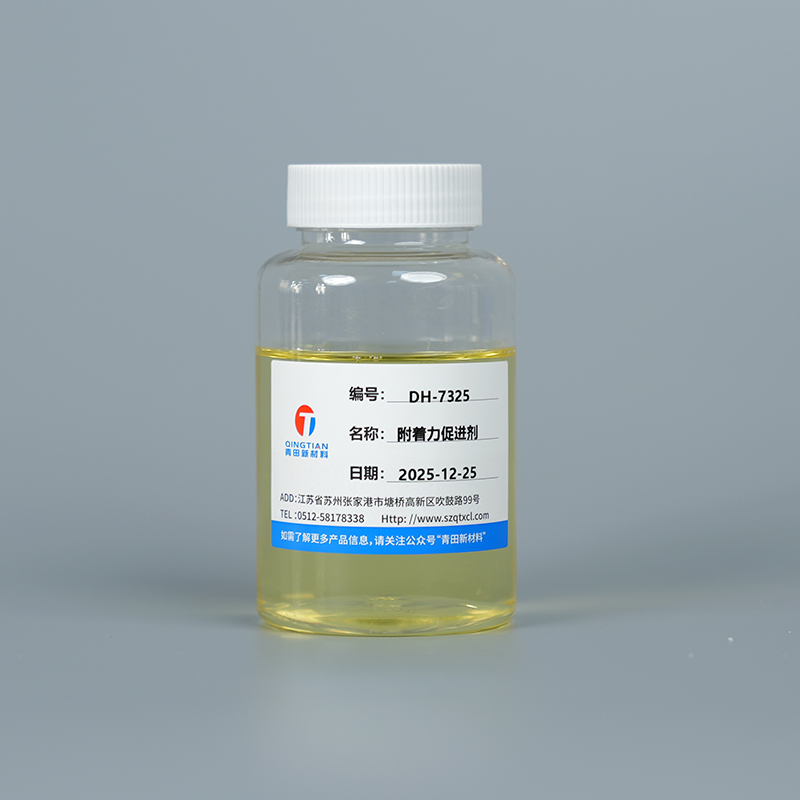
DH-7208 is a substrate treatment agent developed specifically for low-surface-energy materials, including PP, PE, POM, and EPDM rubber, as well as selected stainless steel substrates. It is designed to provide a stable, consistent surface foundation for subsequent PU coating, thermoplastic coating, and vacuum plating processes.
| Performance Area | Effect | Application Relevance |
| Interfacial Bonding | Improves the interface bonding state between substrate and subsequent coating layer | Addresses the root cause of adhesion failure on low-energy plastics |
| Adhesion Strength | Measurable improvement in coating adhesion on treated substrates | Reduces flaking and peeling risk in production and end use |
| Shrinkage Control | Reduces film-formation shrinkage impact from uneven surface treatment | Improves dimensional and appearance consistency on complex geometries |
| Boiling Water Resistance | Supports adhesion retention under high-temperature, high-humidity exposure | Relevant for automotive and outdoor-use component specifications |
| Halogen-Free Formulation | Meets halogen-free formulation requirements where specified | Supports compliance-driven material selection in plastic spray and surface treatment |
Substrates and Downstream Processes Supported
PP
PE
POM
EPDM Rubber
Stainless Steel
PU Coating
Thermoplastic Coating
Vacuum Plating
Application Notes
| Parameter | Guidance |
| Surface Preparation | Substrate should be clean and free of release agents, oils, or processing residues before treatment application |
| Application Method | Compatible with standard spray or dip application equipment used in plastic surface treatment lines |
| Process Sequence | Apply as a pre-treatment step prior to PU, thermoplastic coating, or vacuum plating processes |
| Drying / Flash-Off | Allow appropriate flash-off time before topcoat application; confirm timing in your specific production line trial |
Frequently Asked Questions
Can chemical substrate treatment be combined with flame or corona treatment for additional improvement?
Yes, in many production lines chemical substrate treatment is used alongside physical pre-treatment methods rather than as a strict replacement. Combining approaches can provide additional margin in demanding adhesion specifications, particularly for parts with complex geometry where physical treatment uniformity is difficult to guarantee across the entire surface.
Is DH-7208 suitable for vacuum metallisation (vacuum plating) processes?
Yes. DH-7208 is formulated to provide a stable surface foundation compatible with subsequent vacuum plating processes, in addition to PU and thermoplastic coating applications. The treated surface should be evaluated for the specific metallisation process and base coat system used in your production line.
Does this product work on rubber substrates as well as rigid plastics?
Yes, EPDM rubber is one of the substrate types DH-7208 is designed to address, alongside rigid plastics such as PP, PE, and POM. Rubber substrates often present additional surface chemistry and flexibility-related adhesion challenges, so application trials on the specific rubber compound and coating system combination are recommended.
Key Takeaway
Adhesion difficulty on PP, PE, and similar low-energy substrates originates in the fundamental surface chemistry of the material, not in the topcoat formulation. While physical treatment methods such as flame or corona treatment remain useful tools, their effectiveness depends heavily on equipment consistency and part geometry. A chemical substrate treatment agent provides a more uniform and process-flexible route to establishing the interfacial bonding needed for durable adhesion — supporting downstream PU coating, thermoplastic coating, and vacuum plating processes across a broad range of difficult substrates.
Request Technical Data & Samples for DH-7208
Our technical team can provide TDS, application guidance, and substrate-specific trial support for your plastic spray or surface treatment process.