


 русский
 Español
 Français
Home / News / Industry News / Can silicone be used as an antifoaming agent?: Practical Applications, Selection
Industry News

Content
Yes. Silicone can be used as an antifoaming agent, and in practice it is one of the most technically reliable antifoaming chemistries available to formulators today. Polydimethylsiloxane, the most common silicone used in defoaming products, combines an extremely low surface tension with rapid spreading behavior and very low water solubility. These three properties give silicone defoamers the ability to break foam quickly, suppress new foam over long production runs, and remain stable across a wide range of temperatures and pH levels.
Foam is a practical problem in almost every liquid manufacturing process. In coatings, inks, and adhesives, trapped air creates pinholes, craters, and surface roughness; it slows filling lines, changes viscosity readings, and can cause rejected batches. The real question is not whether silicone can serve as an antifoaming agent, because it clearly can. The more practical question is how to select the right silicone defoamer type, what dose to use, where to add it in your process, and how to avoid the surface defects that sometimes accompany silicone chemistry. This article answers those questions from a raw material manufacturer's perspective, using real formulation logic and test data.
Foam consists of gas bubbles separated by thin liquid films called lamellae. When the liquid contains surfactants, wetting agents, emulsified resins, or proteins, these films become elastic and difficult to rupture. An antifoaming agent must enter the liquid-air interface, spread, and destabilize the film so that the bubble collapses. The effectiveness of an antifoaming agent therefore depends on its surface properties, its solubility, and its droplet size in the final formulation.
Silicone fluids, especially polydimethylsiloxane, perform exceptionally well in this role for several physical and chemical reasons.
The physical mechanism that explains most silicone defoamer behavior is the bridging-stretching effect. When a small silicone droplet contacts the surface of a foam film, it spans the full thickness of that film. As liquid drains from the lamella, the droplet is compressed, and a bridge forms between the two air-water interfaces. Continued film drainage pulls the bridge, stretching it until it ruptures. Once the bridge breaks, the bubble collapses. Because the silicone droplet is insoluble, it can repeat this action many times before being exhausted or carried out of the system.
This is why silicone defoamers tend to deliver both fast foam knockdown and long-lasting suppression. Organic defoamers work by a similar mechanism but often require higher dosages, because they are partially soluble in the formulation and lose activity more quickly. The trade-off is that silicone's strong spreading behavior can also cause film defects, such as fish eyes and craters, when it is overdosed or poorly dispersed.
| Property | Silicone defoamer | Organic defoamer |
|---|---|---|
| Surface tension | 20–21 mN/m | 25–35 mN/m |
| Water solubility | Practically insoluble | Partially soluble or dispersible |
| Foam knockdown speed | Very fast | Fast to moderate |
| Suppression duration | Long | Short to medium |
| Heat resistance | Up to 200 °C and above | Limited by flash point |
| Effective pH range | 2–12 in most grades | Depends on chemistry |
| Risk of film defects | Higher if overdosed | Lower |
The values in this table are general ranges, not specification limits. Each defoamer grade is formulated differently. An emulsified silicone defoamer will behave quite differently from a pure PDMS compound, and a polyether-modified silicone can close most of the compatibility gap in clear and solventborne coatings. Always test the specific grade in your own formulation before scaling up.
Suppliers do not simply sell "silicone defoamer." The product category includes several distinct forms, each engineered for a different kind of foam problem and a different class of formulation. Knowing these forms helps you ask the right questions and makes it easier to compare products from different raw material suppliers.
Straight polydimethylsiloxane oils available in different viscosities, typically from 50 cSt to 100,000 cSt. They are heat-stable and used mainly in solventborne inks, industrial oils, and non-aqueous systems. In waterborne formulations they are rarely used alone because they are difficult to dispers uniformly and tend to float to the surface.
PDMS or compound droplets stabilized in water with emulsifiers. These are the easiest silicone defoamers to incorporate into waterborne paints, adhesives, and inks. Droplet size usually ranges from 1 µm to 10 µm, and smaller droplets generally mean better compatibility but weaker defoaming power.
PDMS blended with hydrophobic silica or other fillers. The silica particles give the droplet a harder surface and help it penetrate the foam lamella. Compounds deliver stronger defoaming and longer suppression, and they are widely used in both waterborne and solventborne industrial coatings.
Siloxanes grafted with polyether chains, such as polyethylene oxide or polypropylene oxide. These are partially water-dispersible, create fewer surface defects, and are often the first choice for clear coats, UV-cured coatings, and overprint varnishes where optical clarity matters.
Silicone actives absorbed onto silica, wax, or other solid carriers. They are used in cementitious systems, dry-mix mortars, joint compounds, and powdered detergents where a liquid additive is difficult to handle or where the product will be stored as a dry powder.
Choosing the right form is often more important than choosing the brand. A silicone emulsion with fine droplet size is an excellent starting point for acrylic latex paint. A solvent-diluted silicone fluid works better in solventborne gravure ink. A compound is more reliable for high-shear pigment dispersion. A polyether-modified silicone is the safe route for a clear wood coating.
| Form | Typical carrier | Best suited for | Main limitation |
|---|---|---|---|
| Fluid | None or solvent | Solventborne inks, metalworking fluids, crude oil processing | Poor dispersion in water |
| Emulsion | Water | Waterborne paints, latex adhesives, cleaning chemicals, fermentation | May break under freeze-thaw cycles or very high shear |
| Compound | PDMS plus silica | High-shear coatings, pulp and paper, textile processing | Requires good mixing to prevent cratering |
| Polyether-modified | Self-dispersing polymer | Clear coats, UV-curable coatings, overprint varnishes | Higher cost per kilogram of active material |
| Powder | Silica, wax, minerals | Dry-mix mortars, cementitious products, soaps | Less effective in low-solids liquids |
If you are formulating a waterborne acrylic wall paint and foam appears only during the let-down stage, a fine-particle silicone emulsion is a logical starting point. If your production line uses a high-speed dissolver above 2,000 rpm, choose a compound that can withstand that shear without losing activity. If the final coating must be transparent and recoatable, polyether-modified silicone will usually provide the best balance of foam control and film clarity.
Foam generation differs from one production line to another. In a paint plant, foam appears during pigment grinding and again during let-down. In an ink plant, foam builds in recirculation pumps. In an adhesive line, air is introduced during high-speed mixing and again at the coating head. Selecting a defoamer requires understanding which stage creates the most foam and how the defoamer will behave under that specific shear and temperature.
Waterborne acrylic, styrene-acrylic, and polyurethane dispersions contain surfactants that stabilize foam strongly. The highest foam levels usually occur during pigment dispersion, when the grinding resin stablizes entrained air, and again during let-down when the coalescent and other additives are mixed in. A common technical approach is to split the defoamer addition: one third to the grind stage to control early foam, and the remainder to the let-down stage to handle the second generation of air bubbles.
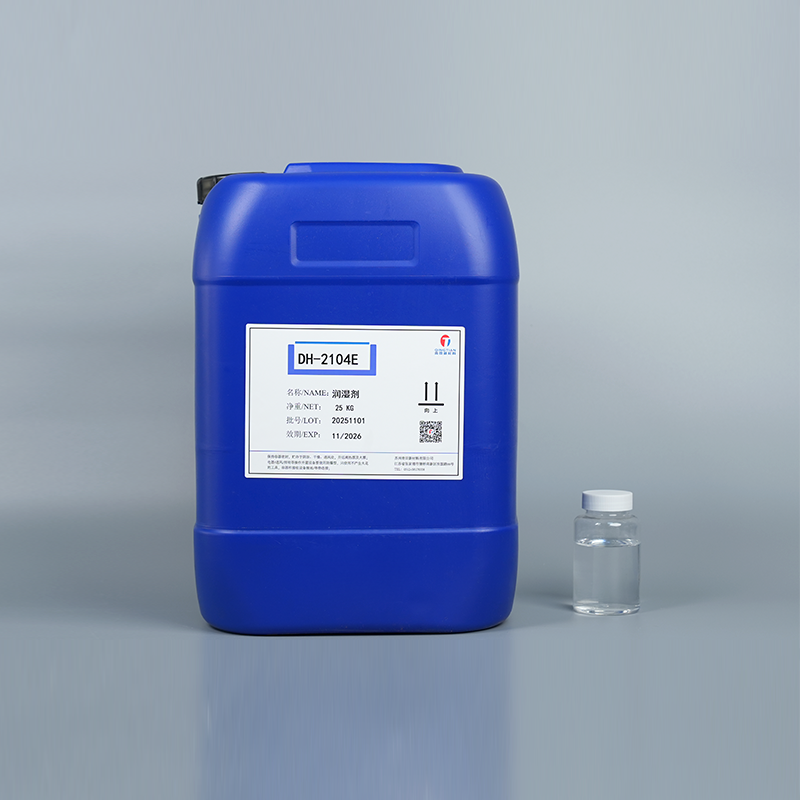 DH-2104E Water-based Defoamer for Paint ProductionThis silicone emulsion defoamer is formulated to withstand production shear and control foam during grinding and let-down stages, making it a practical choice for waterborne coating formulators seeking clean film appearance.View Product →
For a waterborne system, a silicone emulsion defoamer such as the DH2104E water-based defoamer is formulated to tolerate the shear level of typical paint production while maintaining clean film appearance at the recommended dose. The droplet size is controlled so that the defoamer can enter foam lamellae quickly, but not so large that it creates craters. When evaluating this type of product, always test it under production-like shear. A defoamer that looks perfect in a gentle laboratory shake test can fail when circulated through a high-speed dissolver or a recirculation pump for one hour.
Solventborne systems foam less than waterborne ones, but they still trap air during dispersion, especially when the resin has surfactant impurities or when the solvent blend has a low boiling point. A solvent-compatible silicone compound with fast spreading is often effective at 0.05–0.2% by total formula weight. Because the solvent already lowers the interfacial tension, a diluted silicone fluid is sometimes sufficient, and this reduces the risk of recoatability problems.
Flexographic and gravure inks are recirculated continuously, so foam can build quickly in the pump and return system. The ideal defoamer for ink must be fast-acting and stable in a low-viscosity liquid. Water-based inks generally respond well to a silicone emulsion with small droplet size, while solvent-based inks respond better to a solvent-diluted silicone fluid. Overdosing is the most common issue in inks: too much silicone causes poor wetting on plastic films, visible orange peel, and weak intercoat adhesion. Start at 0.1% and increase in small increments.
Water-based adhesives, including pressure-sensitive adhesives and packaging laminating adhesives, are mixed at high speed and then coated at high line speed. Entrapped air creates voids that weaken the bond and cause visible bubbles under transparent films. Silicone defoamers at 0.1–0.4% control most foam problems. The coating method matters: roll coating creates moderate shear, spray coating creates very high shear, and curtain coating traps air in a different way. Confirm which method your customer uses before recommending a defoamer grade.
There is no universal "best defoamer" for every formulation. Silicone offers the strongest foam control per unit weight, which is why it dominates many industrial applications. But its strength is also its risk: silicone spreads aggressively, and if it is not fully incorporated or if the dose is too high, it creates fish eyes, craters, and loss of gloss. Silicone-free defoamers are more forgiving and create fewer film defects, but they usually require higher dosages and may lose effectiveness at elevated temperatures.
The choice between silicone and silicone-free chemistry should be based on the following factors:
| Selection factor | Silicone defoamer | Silicone-free defoamer |
|---|---|---|
| Foam knockdown speed | Very fast | Moderate to fast |
| Long-term suppression | Excellent | Limited, often requires re-dosing |
| High-temperature stability | Excellent | Fair to poor |
| Risk of fish eyes and craters | Higher if overdosed | Lower |
| Recoatability | Can interfere | Usually safe |
| Clear-coat compatibility | Use modified grades | Generally good |
| Typical effective dosage | 0.05–0.5% | 0.2–1.0% |
 DH-2020 Silicone-free Defoamer for High-Solid SystemsA non-silicone defoamer that offers fast foam release in waterborne and solventborne systems, reducing cratering and intercoat adhesion risks while suiting high-solid and solvent-free applications.View Product →
For formulators who need to eliminate any risk of silicone contamination on the film surface, a non-silicone defoamer such as the DH2020 defoamer is the safer starting option. It provides fast foam release in both waterborne and solventborne systems, with much lower cratering and intercoat adhesion risk. The limitation is a shorter suppression period, so it often needs to be added in two stages: part at the grind stage and part at let-down.
In some cases, the two chemistries can be combined. A small amount of silicone defoamer is added first to knock down persistent foam, and a silicone-free defoamer is used later to maintain surface quality. This approach requires careful testing because the interaction between two defoamer systems is not always predictable.
Dosage is the most common source of defoamer problems in production. Too little defoamer leaves visible foam; too much creates surface defects that ruin the appearance of the film. Silicone defoamers are powerful at low concentrations, so their practical dosage window is usually narrower than that of organic defoamers.
Percentages are based on total formulation weight. Start near the lower end and increase only if foam persists after a full production-cycle simulation.
For a waterborne architectural coating, a typical starting point is 0.2% of a silicone emulsion defoamer. If the paint is applied by brush and roller, the defoamer must also survive the high shear of the roller. For a solventborne industrial coating, 0.1% of a silicone compound is often enough. For a UV-curable coating, use a polyether-modified silicone at 0.1–0.3% to avoid haze and clarity loss.
Most commercial silicone defoamers are ready-to-use blends and should be added as supplied. If you need to reduce the concentration for a dosing system, never dilute a compound with plain water. The emulsion can separate, causing the active silicone phase to float to the surface. Instead, pre-dilute the defoamer with a solvent or coalescent from your own formula, or select an emulsion grade that is specifically designed for water dilution.
 DH-2277S Water-based Defoamer for Micro-foam ControlA non-silicone vegetable oil emulsion defoamer designed for rapid defoaming and suppression of micro-bubbles, with good compatibility and suitability for automatic dosing equipment in water-based systems.View Product →
Water-based systems that require a low-viscosity defoamer for automatic dosing equipment are often served well by products like the DH2277S water-based defoamer. It is designed to remain pumpable and stable under continuous metering conditions. When using any defoamer in dosing equipment, check that the product does not separate during overnight circulation, because this changes the effective dose being delivered.
Supplier technical datasheets give initial guidance, but only your own formulation, equipment, and application method can tell you whether a defoamer will perform. Use the following tests before approving a new grade for production.
Place 100 mL of the fully formulated product in a 250 mL graduated cylinder. Close the cap and shake vigorously for 30 seconds. Record the foam height immediately, then again at 1 minute, 2 minutes, and 5 minutes. This measures both knockdown speed and suppression duration.
Use a laboratory dissolver or a high-speed household-style mixer to simulate production shear. Run the formulation at the same speed and for the same duration as your production process. This reveals whether the defoamer survives real-world mixing or breaks down and loses activity.
Cast a film on a sealed black chart or a glass panel. Let it dry under controlled conditions and inspect for craters, fish eyes, haze, and gloss variation. Compare the film made with defoamer against a control film without defoamer to see the additive's actual effect.
Apply a second coat over the dried first coat, or overcoat with a different topcoat system. Check intercoat adhesion by cross-hatch tape pull-off. This test is essential if your coating will be top-coated in the customer's process.
These four tests together cover the main risks: foam remaining, foam returning, film defects, and adhesion failure. They do not require specialized instruments, so they can be run in any small laboratory. For very high shear processes, such as curtain coating or high-speed pad printing, add a pump-circulation test with a small gear pump to simulate the repeated shear that the defoamer will experience over an entire shift.
Yes, in industrial use silicone defoamers are safe when the selected grade complies with the regulations that apply to your market. Many silicone defoamers meet FDA 21 CFR 173.340 for food processing and similar EU food-contact requirements. However, you must verify that the specific product you purchase has the appropriate regulatory status for food packaging, pharmaceutical, or cosmetics applications. The regulation status is grade-specific, not chemistry-wide.
Craters appear when the silicone droplet is too large or when the dosage exceeds the compatibility limit of the formulation. Silicone spreads aggressively, and large droplets create low-surface-tension islands on the wet film surface. To correct the problem, reduce the dosage, add the defoamer earlier so it receives more shear during mixing, or change to a fine-particle emulsion. In many cases, reducing the dose by half eliminates the craters while still controlling the foam.
For most waterborne paints and inks, start at 0.1% of the total formula. For solventborne systems, start at 0.05%. Increase the dose in 0.05% increments until foam is controlled. If you reach 1.0% and foam still persists, the defoamer is not compatible with your formula, and switching chemistry is more effective than increasing the dose further.
Yes, but you should choose a polyether-modified silicone or a defoamer grade designed for clear systems. Standard PDMS compounds create haze and a slight orange-peel effect even at moderate doses. A modified silicone can be used at 0.05–0.1% in a clear acrylic or polyurethane coating with little or no visible effect on transparency.
Most silicone defoamers have a shelf life of 12 months when stored in sealed containers at 5–35 °C. Avoid freezing, because repeated freeze-thaw cycles can break the emulsion and cause the silicone phase to separate. If the product settles during storage, stirring it gently can often restore uniformity. If it separates into layers that do not re-emulsify after stirring, discard the container and use a fresh batch.
A defoamer works at the surface to break existing foam bubbles. A deaerator works inside the bulk liquid to help micro-bubbles coalesce into larger bubbles that rise to the surface faster. Silicone defoamers can provide some deaerating effect, but in high-viscosity systems with many fine bubbles, a dedicated deaerating additive is often required. If your problem is micro-foam that appears only after the film is applied, a defoamer alone may not solve it.
Silicone is not just an antifoaming agent; in most waterborne systems it is the highest-performing option available. The key to successful use is balancing its foam-breaking power against the risk of surface defects. Base your selection on four questions:
Once those answers are clear, the choice among a silicone emulsion, a silicone compound, a polyether-modified silicone, or a silicone-free defoamer becomes much easier. A well-chosen defoamer, added at the right stage and at the right dose, does more than remove foam: it improves production speed, reduces batch rejection, and protects the appearance and performance of the final film.
For further reading on additives selection, see our guide to acrylate leveling agents in industrial coatings. You can also check the latest industry news for formulation comparisons and additive application guidance.
 Wholesale Paint/ Coating Additives Manufacturers
Custom Industrial Chemical Solutions Suppliers
Wholesale Paint/ Coating Additives Manufacturers
Custom Industrial Chemical Solutions Suppliers