


 русский
 Español
 Français
Home / News / Industry News / Waterborne Adhesion Keeps Varying Between Batches — The Interface Is Where to Look
Industry News

In a waterborne system, achieving good initial adhesion on a specific substrate is one performance requirement. Maintaining it consistently across different humidity conditions, substrates, and storage periods is a different and more demanding challenge. If the interface between inorganic fillers and the polymer binder is not well-matched, neither of these requirements can be fully met — and the results show up as adhesion variability, insufficient mechanical performance, or system changes during storage.
The coating bonds inconsistently to the substrate — results vary between batches, humidity conditions, or substrate surface states, making it difficult to achieve reliable specification compliance.
Uneven particle distribution reduces system homogeneity, affecting both application behaviour and the uniformity of film properties across the coated surface.
Bending strength, tensile strength, impact resistance, and elasticity below specification — all of which can trace back to inadequate bonding at the filler-polymer interface rather than bulk resin weakness.
System properties change during extended storage — viscosity shifts, filler settling, or performance drift that creates inconsistency between freshly made and stored product.
The standard response to waterborne adhesion problems is to increase resin content or modify cure conditions. These approaches improve the bulk film properties but do not address what happens at the filler-polymer boundary. When inorganic fillers and the polymer matrix are not chemically compatible at their shared interface, the adhesion energy across that boundary is limited — and no amount of bulk resin adjustment can fully compensate for a weak interface.
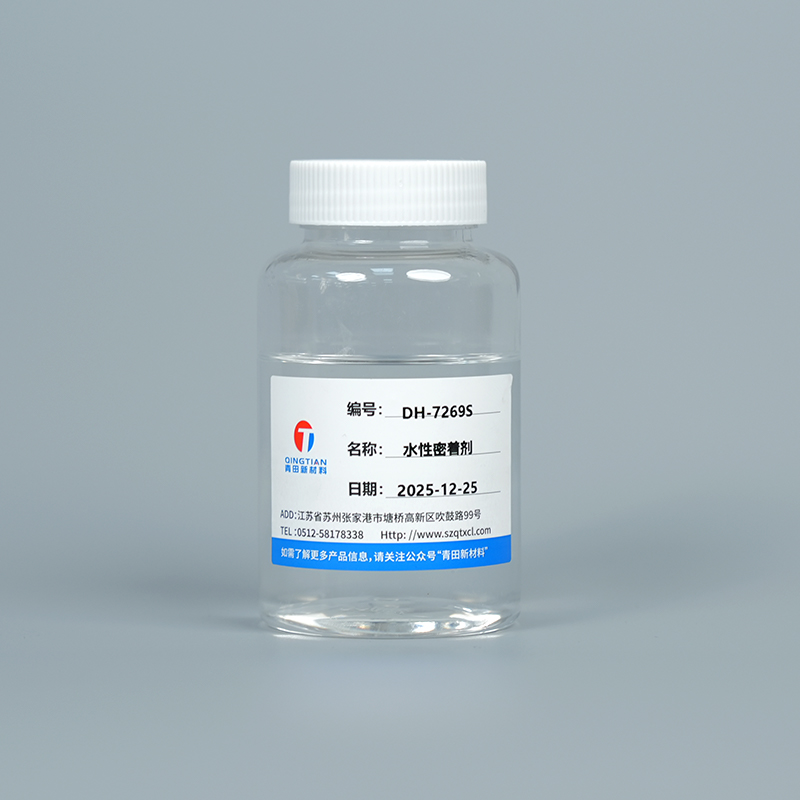
DH-7269S is an epoxy-modified polysiloxane coupling agent designed to improve the interface between inorganic fillers and the polymer binder in waterborne systems. Its epoxy functional groups participate in the bonding reaction between the inorganic filler surface and the organic polymer network, improving the chemical connection across the interface rather than relying on physical contact alone.
| Adhesion Stability | Epoxy-mediated interfacial bonding improves adhesion consistency across substrate types and environmental conditions |
| Filler Dispersion | Improved interface compatibility supports more stable filler distribution within the polymer matrix |
| Flexural & Tensile Strength | Stronger interface bonding transmits stress more efficiently through the composite, supporting improved mechanical results |
| Impact Resistance | Better load transfer at the interface reduces stress concentration that leads to impact-induced failure |
| Elasticity | Improved interfacial coupling supports the elastic response of the composite under dynamic loading |
| Storage Stability | Better interface compatibility reduces property drift during long-term storage |
| Application Scope | Suitable for waterborne coatings, waterborne sealants, waterborne adhesives, and metal surface treatment |
Does DH-7269S work with all types of inorganic fillers?
It is designed to improve the filler-polymer interface in waterborne systems broadly. Effectiveness depends on the specific filler surface chemistry — silica-based, alumina-based, and similar mineral fillers generally respond well to epoxy-siloxane coupling chemistry. A small-scale trial with the specific filler is recommended to confirm the effect.
Can it be added to an existing waterborne formulation without other changes?
In most cases, yes — it is evaluated as an additive within the existing formulation. Because it improves interface bonding through a reactive mechanism, the addition sequence (pre-treatment of filler vs. addition to the mixed system) can affect performance, and this is worth evaluating in the trial.
Will it affect the open time or pot life of the waterborne system?
At normal dosage levels, the epoxy reactivity of DH-7269S operates primarily at the filler surface rather than in the bulk liquid phase, so significant pot-life effects are not typical. A stability check on the specific formulation is still recommended before production use.
Is it suitable for both room-temperature-cure and elevated-temperature-cure waterborne systems?
Yes — the epoxy-siloxane chemistry is active across a range of cure temperatures and is not limited to elevated-temperature cure schedules.
In waterborne systems, unstable adhesion and limited mechanical performance often originate at the filler-polymer interface — a zone that bulk resin adjustment alone cannot improve.
Experiencing unstable adhesion, insufficient mechanical properties, or storage stability issues in your waterborne system? Request technical data and a sample of DH-7269S.
 Wholesale Paint/ Coating Additives Manufacturers
Custom Industrial Chemical Solutions Suppliers
Wholesale Paint/ Coating Additives Manufacturers
Custom Industrial Chemical Solutions Suppliers