русский
 Español
 Français
Industry News
Crackle Paint, Crackle Paint Resin and Texture Paint for Glass and Metal Surface Finishing
Crackle paint is a special-effect coating material formulated to produce a natural, irregular cracking pattern on the surface of finished products. As a manufacturer that produces this coating in-house, we formulate, test and pack every batch of crackle paint under controlled conditions so that the cracking density, gloss level and film hardness stay consistent from one production run to the next. Crackle paint is widely used on glass cups, wine glasses, cosmetic bottles, perfume bottles and lamps, and it performs equally well on thermos flasks, hardware components, bicycle parts, lighters, razors, lipstick caps, security doors, scissors, tea sets and handicrafts. The coating is built around a specialised resin system, and when this resin is discussed on its own it is generally referred to as Crackle Paint Resin, since the resin fraction is what actually controls how the cracking pattern forms during drying.
Where Crackle Paint Is Used on Glass Substrates
Drinkware and Tableware
Glass cups, wine glasses and tumblers finished with crackle paint gain a frosted, ice-fractured surface that changes the way light passes through the glass wall. The coating is applied to the exterior of the vessel so the interior stays food-contact clean and easy to wipe down.
Cosmetic and Perfume Packaging
Cosmetic bottles and perfume bottles are among the most demanding glass substrates because the coating has to survive repeated handling, occasional exposure to alcohol-based liquids and long shelf display without the cracking pattern flattening out or losing its texture.
Lighting and Decorative Glass
Lamp shades and decorative glass panels coated with crackle paint diffuse light unevenly across the crack lines, producing a soft, textured glow rather than a hard, direct beam, which is why the coating is often requested for ambient lighting fixtures.
Where Crackle Paint Is Used on Metal Substrates
Thermos Flasks and Hardware
Stainless steel thermos flasks and general hardware parts are coated with crackle paint to hide surface polishing marks left over from the metal forming stage, while the cracking pattern itself becomes a deliberate design feature rather than a defect to cover up.
Small Metal Accessories
Lighters, razors and lipstick caps have limited surface area and tight tolerances, so the coating needs a viscosity that lays down evenly without pooling in corners; crackle paint at the correct viscosity range covers these small parts without clogging fine mechanical features.
Larger Metal Fixtures
Security doors, scissors, tea sets and handicrafts are coated in larger batches, and on these bigger surfaces crackle paint is frequently combined with texture paint, where texture paint builds a raised base layer and crackle paint develops the fracture pattern on top of it.
Product Gallery
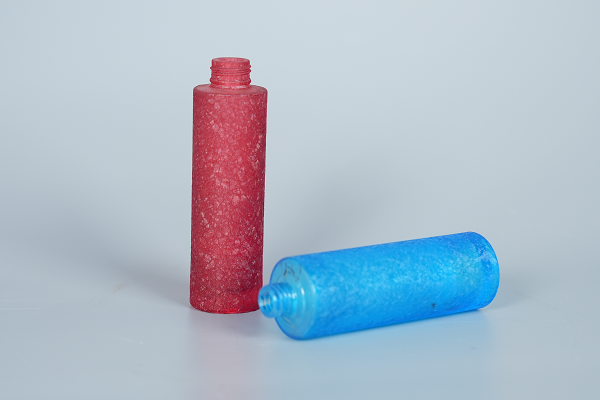 Crackle paint finish on red and blue glass bottle samples, showing the fine, uniform fracture pattern across a curved surface.
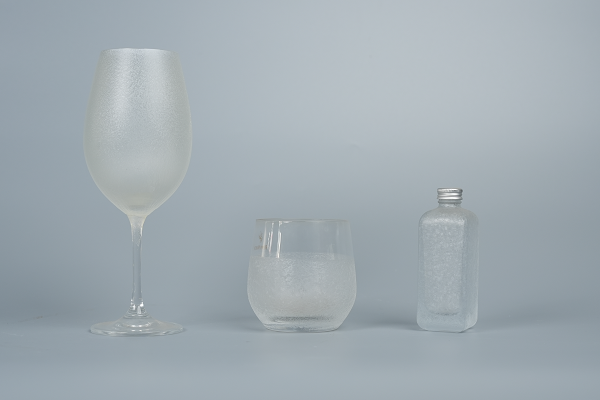 A wine glass, tumbler and small glass bottle finished with a matched frosted crackle paint texture across three different glass shapes.
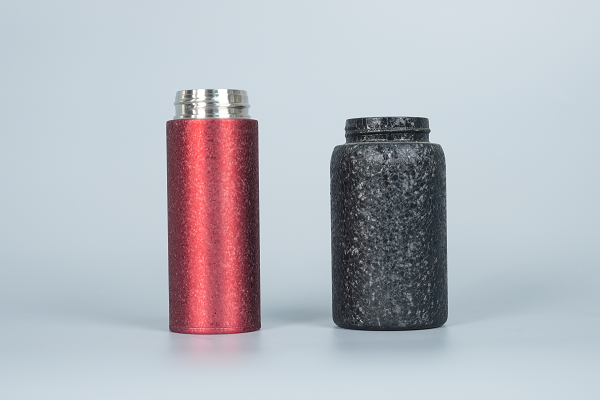 Metal thermos flask samples showing crackle paint in a red metallic finish next to a texture paint finish in dark granular black.
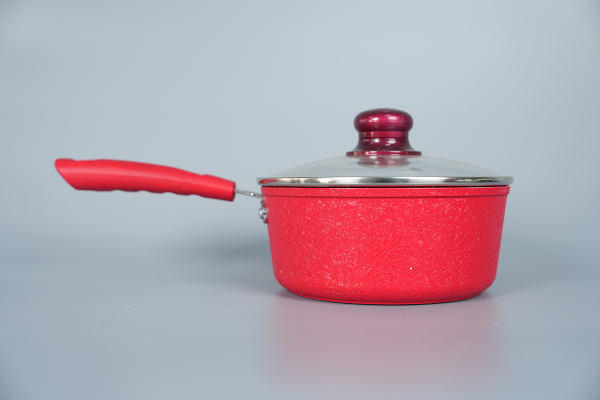 Side-by-side comparison of a crackle paint metallic red finish and a texture paint dark speckled finish on identical thermos bodies.
Physical Parameters
Every batch of crackle paint leaving our facility is checked against the same set of physical parameters before it is approved for packing. These figures are the reference point our technical team uses when a customer asks whether the coating is suitable for a particular substrate or application method.
| Parameter | Specification |
|---|---|
| Appearance | Slightly turbid, viscous liquid |
| Solid content | 70% ± 2 (tested at 150°C / 1h) |
| Viscosity | 350–600 (G–H / 20°C, rotor 2#, 60RPM) |
| Solvent system | Butyl acetate, n-butanol |
The 70% ± 2 solid content figure means the film left behind after solvent evaporation is thick enough to develop a visible crack network without needing multiple coats. The 350–600 viscosity range at 20°C is deliberately kept in the middle band rather than at either extreme: below this range the crack lines tend to come out too fine and closely spaced, and above it the film can sit unevenly on curved or vertical surfaces such as a wine glass stem or a lighter body.
What Crackle Paint Resin Actually Does
Crackle Paint Resin is the film-forming component inside crackle paint, and it is the part of the formula responsible for the cracking behaviour itself. As the solvent evaporates, the resin shrinks faster at the surface than it does deeper inside the film. That mismatch in drying speed builds up internal stress, and once the stress exceeds what the film can hold, it releases along a network of fracture lines. The size, spacing and direction of those lines are not random noise — they are a direct result of how the resin is formulated, how thick the coat is applied, and how the surrounding temperature and humidity behave while the film is drying. A resin with the wrong shrinkage ratio will either fail to crack at all or crack so aggressively that flakes of coating start lifting off the substrate, which is why the resin fraction is treated as a separate technical topic from the finished crackle paint product.
Texture Paint as a Complementary Finish
Texture paint works on a different principle from crackle paint. Instead of relying on shrinkage stress, texture paint builds its surface effect from solid particles suspended in the coating that physically stack up as the film dries, giving a grainy, tactile surface rather than a network of fine cracks. On its own, texture paint is used where a supplier wants a rough, matte, almost stone-like hand feel — the dark speckled finish seen on some metal caps and jar-style containers is a typical texture paint result. When texture paint is applied as a base layer and crackle paint is layered on top, the two effects combine: the underlying grain from texture paint adds depth, and the crack lines from the crackle paint layer sit on top of that texture rather than on a flat surface, which produces a more complex finish than either coating could achieve by itself.
Production and Quality Control
Batch-to-Batch Consistency
Solid content and viscosity are measured on every production batch, not sampled occasionally, so a customer reordering the same crackle paint code six months later receives a film that dries and cracks the same way as the first shipment.
Color and Effect Matching
Crackle paint and texture paint are both produced in a range of base colors and metallic tones, and color panels are kept on file so a repeat order can be matched against a physical reference rather than a screen display.
Application Testing
Before a new substrate goes into production, small test pieces are coated and cured under the customer's intended process conditions to confirm the crack pattern and film adhesion before a full production run is scheduled.
Common Questions About Crackle Paint
What causes the cracking pattern in crackle paint to form?
The cracking comes from uneven shrinkage inside the crackle paint resin as the solvent evaporates. The surface of the film dries and contracts faster than the layer underneath it, and the resulting internal stress splits the surface into a network of fine cracks rather than letting it dry as a smooth, unbroken film.
How is crackle paint resin different from texture paint?
Crackle paint resin creates its effect through controlled shrinkage stress in the dried film, producing fine crack lines. Texture paint instead relies on solid particles suspended in the coating that build up a grainy, three-dimensional surface. The two rely on different physical mechanisms, which is why they are often paired together for a layered finish.
Which glass and metal substrates can crackle paint be applied to?
On glass, crackle paint is applied to glass cups, wine glasses, cosmetic bottles, perfume bottles and lamps. On metal, it is applied to thermos flasks, general hardware, bicycles, lighters, razors, lipstick caps, security doors, scissors, tea sets and handicrafts.
Why does the viscosity of crackle paint matter for the finished effect?
Viscosity controls how the wet film sits on the substrate before it starts to dry. At 350–600 (G–H / 20°C, rotor 2#, 60RPM), the coating is thick enough to build a film with visible cracking but fluid enough to lay down evenly on curved surfaces such as bottle necks, glass stems or cylindrical metal bodies.
Can crackle paint and texture paint be combined on the same product?
Yes. Texture paint is typically applied first to build a grainy base layer, and crackle paint is applied over it once the base has cured. The crack lines then develop across the textured surface, producing a finish that carries both the raised grain of texture paint and the fracture network of crackle paint.
Does crackle paint perform the same way on glass and on metal?
The resin's shrinkage behaviour is the same regardless of substrate, but the crack pattern reads differently depending on what is underneath it. On glass, light passes through the crack lines, which is why lamps and drinkware coated with crackle paint show a diffused, layered look. On metal, the crack lines sit against an opaque base, so the contrast between the cracked surface and the substrate color is more visually direct.
Color, Packaging and Customization
Crackle paint, crackle paint resin and texture paint are available in standard base colors as well as metallic and pearlescent variants, and custom color matching can be arranged against a physical sample or a Pantone reference. Packaging is typically supplied in sealed metal or plastic containers sized for production-line use, and container size can be adjusted to match a customer's coating line throughput. For customers running trial production before committing to a full order, small sample quantities of crackle paint, crackle paint resin or texture paint can be prepared in the same formulation as the production batch, so trial results on glass or metal test pieces carry over directly once the order moves to full-scale coating.
Technical support during the trial phase covers substrate compatibility, recommended film thickness, curing temperature and drying time, since these four variables have the biggest influence on how the final crackle paint or texture paint surface turns out. Adjusting any one of them — a thicker wet film, a slightly warmer curing environment, or a longer open time before the piece goes into the oven — will change the density and direction of the crack pattern, and our technical team works through these variables with the customer during sample approval so the production result matches what was agreed on during testing.