


 русский
 Español
 Français
Home / News / Industry News / What Are Silicon-Based Defoamers? A Practical Coating Formulator's Guide
Industry News

Content
A shipment of waterborne industrial coating left the plant with a clean batch record and arrived at the customer's filling line with a thin layer of microfoam sitting on top of every drum. After application, that foam turned into pinholes, and the pinholes turned into craters. The batch was rejected. The root cause was not the resin, not the pigment dispersion, and not the curing agent. It was one kilogram of silicone-based defoamer that had been doubled during the mill base stage to solve a problem that had already been solved three batches earlier.
Silicone-based defoamers are additives whose foam-breaking activity comes from silicone chemistry, meaning siloxane polymers and their copolymers, rather than from mineral oil, wax, or plain polyether. They are dosed typically at 0.05 percent to 0.5 percent on total formulation weight, and they both destroy foam that has already formed and prevent new foam from stabilising. They act faster than any other defoamer family and they hold residual antifoam activity longer. That is exactly why they get overused, and exactly why the defects they cause, such as craters, fish eyes, loss of recoat adhesion, and gloss drop, are the defects formulators most often blame on resin, pigment, or substrate.
This article covers the chemistry, the selection criteria, the dosing method, the troubleshooting logic, and the commercial parameters that decide whether a drum of defoamer stabilises your production line or destroys a delivery. Everything below is practical: what a technical data sheet should show, what a laboratory test should prove, and what to do when you are already holding a failed batch.
A silicone-based defoamer is an additive used in waterborne, solventborne, and 100 percent solids systems whose foam-breaking activity originates from siloxane polymers. A typical industrial silicone defoamer contains three functional parts:
One terminology point that costs real money: in commercial trade, "silicon-based" refers to silicone chemistry, meaning polymers built on a silicon-oxygen backbone. It does not refer to silicon metal powder or to silane coupling agents. If you request a quotation for a silicon-based defoamer and receive a data sheet for an adhesion promoter, the two sides of the conversation are using different vocabularies.
Silicone-based defoamers also need to be separated from antifoam agents in the narrow sense. A defoamer destroys foam that already exists. An antifoam prevents foam from forming in the first place. Many siloxane products do both, and which behaviour dominates depends on the dose and the point of addition in the process.
Foam in a coating is a thin liquid film stabilised by surfactant molecules. To destroy it, the defoamer must reach the film surface, spread across it, and destabilise it faster than the surfactant can repair the damage. Silicone actives do this through five sequential mechanisms.
The numbers behind this are worth memorising. Water sits at about 72 millinewtons per metre. A typical solventborne coating system sits between 25 and 30. Polydimethylsiloxane sits at 20 to 21. That gap is the reason silicone defoamers work at doses so low, and it is also the reason they cause craters. A silicone active cannot distinguish between a foam lamella and a wet paint film. Both are thin liquid layers with a surfactant monolayer on top. At the correct dose, the silicone enters foam lamellae and leaves the applied film alone. Above the correct dose, it does not.
This is the single most useful idea in the whole subject: defoaming power and crater risk come from the same physical property. Selection is never a search for the strongest product. It is a search for the product whose balance point sits inside your specific formulation and application window.
Cloud-point behaviour is the second mechanism worth understanding. Polyether-modified siloxanes are designed to be compatible and inactive at storage temperature, then become incompatible and highly active once the system passes a defined temperature during bake or cure. A defoamer with a cloud point of 45 degrees Celsius does very little in a cold-blended waterborne coating, but becomes a strong knockdown agent inside a curing oven. If you specify a cloud-point product in a system that never exceeds 30 degrees during processing, you have paid for performance that never switches on.
Before selecting a specific grade, confirm which of the three main defoamer families belongs in your system. The trade-offs are structural, not grade-specific, and no supplier can engineer them away.
| Selection criterion | Silicone-based | Silicone-free (polyether, wax, acrylic) | Mineral oil and wax blends |
|---|---|---|---|
| Active surface tension | 20 to 21 mN/m | 26 to 34 mN/m | 28 to 36 mN/m |
| Foam knockdown speed | Very fast | Moderate | Slow to moderate |
| Dose efficiency | 0.05 to 0.3 percent typical | 0.2 to 1.0 percent typical | 0.3 to 1.5 percent typical |
| Crater and fish-eye risk | High if overdosed | Low | Low |
| Effect on recoat adhesion | Can reduce it at higher doses | Generally neutral | Can reduce it through oil residue |
| Gloss and clarity impact | Can cause haze in clear coats | Low impact | Moderate haze risk |
| Long-term antifoam persistence | Excellent | Moderate | Moderate to poor |
| Best-fit systems | Waterborne and solventborne industrial coatings, UV inks, adhesives, high-foam grind stages | Clear coats, topcoats where surface quality is critical, food-contact-adjacent formulations | Architectural emulsions, low-demand primers, cost-driven formulations |
Read the table as a decision funnel rather than a ranking. If surface quality is the governing requirement and the system is a clear topcoat, start with a silicone-free product and accept the higher dose. If the problem is violent foam generation in a high-speed grind stage and the film is pigmented, a silicone product at a low dose will solve it in a way no silicone-free product can.
The most common commercial mistake is switching from silicone to silicone-free after a crater complaint, and then discovering that the silicone-free product cannot control foam at any commercially viable dose. The correct response to a crater problem is usually to reduce the silicone dose, move the addition point, or change to a more compatible silicone chemistry, not to abandon the family.
Supplier literature often highlights properties that have little influence on the production line. The following parameters do influence it, and every one of them should appear on the technical data sheet you receive with the sample.
For emulsions, active content typically runs from 20 percent to 60 percent. A 20 percent active emulsion is not a weaker product; it is a more diluted delivery system that may be easier to incorporate but requires roughly triple the dose to deliver the same active mass. Compare products on cost per unit of active, not cost per kilogram of liquid.
Viscosity determines pumpability, drum drainage, and how easily the product disperses into the let-down. A 100 percent active silicone can exceed 10,000 centipoise and needs pre-dilution before addition. Batch-to-batch viscosity drift above 20 percent is a warning sign for consistency.
Emulsion droplet size controls both efficiency and defect risk. Droplets in the 0.5 to 3 micron range generally give the best balance. Larger droplets deliver less surface area and dose less efficiently. Very fine droplets below 0.3 micron disperse extremely well but can be too compatible, reducing knockdown speed.
For waterborne systems this is often the single most important specification. If the cloud point sits below your process temperature, the product activates early and may cause surface defects. If it sits above your cure temperature, the product may never activate at all.
Emulsion defoamers break if the pH swings outside their design window. Confirm the stability range and test it against your actual let-down pH. Also confirm shear stability, because products that survive storage can still coalesce and cream after five minutes in a high-speed disperser.
This is not a data sheet number. It is a laboratory result. Two products with identical specifications can behave completely differently in an acrylic-styrene system versus a polyurethane dispersion.
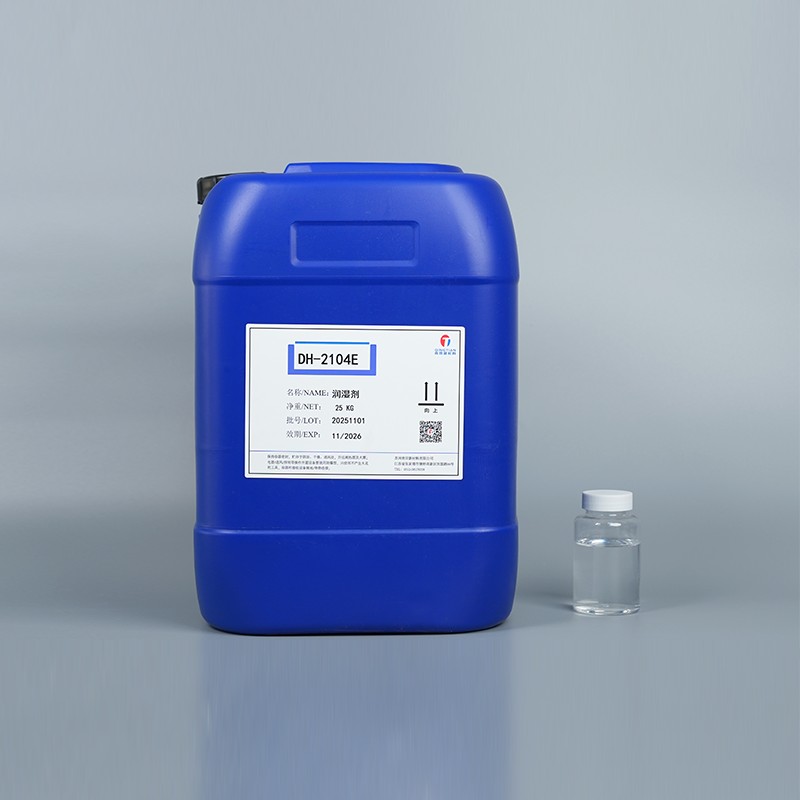 DH-2104E Water-based DefoamerWetting and Anti-foamingView Product →
Once the family is fixed, selection becomes a shortlist exercise. The following guidance is organised by system type, because that is the first question a formulator should answer.
Start with a polyether-modified siloxane emulsion with a cloud point between 25 and 45 degrees Celsius. These products stay compatible at room temperature and activate during drying or bake. Dose in two stages: one third to one half in the grind, the remainder in the let-down. Grind-stage addition controls foam generated by pigment dispersion; let-down addition controls foam from binder and thickener incorporation, which is where most persistent microfoam originates.
Use a 100 percent active silicone or a solution grade. Emulsions have no place in solventborne systems because the water phase will not disperse and can produce haze. Compatibility with the specific solvent blend matters more than active content. Test at the highest pigment loading you expect, because incompatibility often only appears at high solids.
UV systems are unforgiving on two counts: the defoamer must not absorb at the photoinitiator wavelengths, and it must not migrate to the surface and interfere with the crosslink density. Select a silicone product with documented UV compatibility and test cure response, not just foam control. A product that eliminates foam but drops the pendulum hardness by 15 percent is not a solution.
Foam is harder to release because viscosity stays high and bubbles cannot rise. Use low-activity silicone products with high spreading efficiency, and dose at the low end. Overdosing in a 100 percent solids system creates craters that are extremely difficult to repair because there is no solvent to help the film re-level.
Ink films are thin, often below 10 microns. Foam that would be invisible in a 60-micron coating becomes a visible pinhole in an ink layer. Select fine-particle emulsions and dose conservatively, typically 0.1 percent to 0.4 percent. For water-based flexographic and gravure inks, cloud-point selection matters because drying tunnels reach 60 to 90 degrees Celsius.
Here the governing risk is not appearance but bond strength. A silicone defoamer that migrates to the bond line can reduce peel strength significantly. Select low-migration products, keep the dose at the minimum effective level, and validate every change with a mechanical test on the finished joint rather than a visual inspection.
Two formulators can use the same product at the same nominal dose and get opposite results. The difference is almost always the addition method. The following sequence reflects practice that holds up across waterborne and solventborne production.
The chart above reflects working ranges seen in routine production, not theoretical limits. Every range should be narrowed to a single validated number once your system is locked. A specification that says "0.1 to 0.5 percent" gives the production floor too much freedom, and freedom in defoamer dosing is how failed batches are made.
 DH-2020 DefoamerExcellent foam suppression and deaeration effects, especially in high-solid and solvent-free systems.View Product →
Silicone defoamer problems are recognisable by pattern. The defects appear on the whole surface rather than in isolated spots, they appear after a dosing change rather than after a raw material change, and they do not respond to adhesion promoter addition. The table below maps the common symptoms to their most likely causes and corrections.
| Symptom | Likely cause | Corrective action |
|---|---|---|
| Craters and fisheyes across the whole film | Defoamer dose above compatibility limit | Reduce dose by 30 to 50 percent; test at the reduced level before changing product |
| Localised craters near the film edge | Undiluted high-viscosity silicone added as a plug | Pre-dilute and add under controlled shear |
| Loss of intercoat adhesion | Silicone migration to the surface layer | Switch to a more compatible chemistry or reduce dose; verify by cross-hatch test after full cure |
| Gloss reduction in clear coats | Incompatible silicone forming a separate phase | Move to a silicone-free product for the clear coat layer |
| Haze or cloudiness | Emulsion defoamer used in a solventborne system | Replace with a 100 percent active or solution grade |
| Foam persists despite high dose | Product too compatible and no longer surface active | Switch chemistry family; adding more of the same product will not help |
| Foam returns during storage | Dose too low or product consumed during grind | Increase let-down portion of the split dose |
| Defects only in the baked film | Cloud point below bake temperature, causing late activation | Select a product with a higher cloud point |
The most important row in that table is the sixth. When foam persists and the dose keeps rising, the instinct is to add more. But a silicone defoamer that has become fully compatible with the system has stopped being a defoamer. It is now a surfactant, and it will generate the foam it was supposed to destroy. Recognising this early saves weeks of pointless dose escalation.
The same chemistry behaves differently depending on where it is applied. These short notes collect the practical points that come up most often in application work.
Line speeds reach 100 metres per minute and film thickness is low. Foam has no time to release. Use low-dose, fast-knockdown silicone and validate on the actual line, because laboratory roller application does not reproduce the same shear history.
Recoat adhesion between sealer and topcoat is the critical failure mode. Keep silicone dose at the minimum and confirm intercoat adhesion after full cure on the actual wood substrate, not on glass panels.
High film builds trap bubbles that rise slowly. Combine a fast-knockdown grind-stage product with a longer-active let-down product rather than using a single high dose of one product.
Pinholes and pimples show immediately on the printed sheet. Dose in the ink let-down only, and check the dried film under magnification rather than by eye.
Verify cure response after every defoamer change. Measure pendulum hardness and adhesion, not just appearance, because a compatible-looking film can still be under-cured at the surface.
Conductive and functional coatings cannot tolerate surface defects that alter conductivity. Select the lowest-defect chemistry, test sheet resistance before and after defoamer addition, and treat any change above 5 percent as a failure.
Defoamer problems frequently originate before the product reaches the mix tank. Incoming inspection is cheap; a failed delivery is not. The following items should be part of your standard supplier process for silicone-based defoamers.
The compatibility ladder test is the single highest-value item on that list. It takes half a day and it tells you the width of the safe dosing window in your own system rather than in a supplier's generic resin. If the window between "no foam control" and "visible craters" is narrower than 0.1 percent, the product is a poor fit regardless of how good its data sheet looks.
Regulatory pressure on defoamer chemistry has increased steadily and it now influences selection as much as performance does. The main points to track:
For exporters of coatings, inks, and adhesives, the practical advice is straightforward: keep a compliance dossier for every defoamer grade you use, updated annually, and do not assume that a product registered in one market is acceptable in another. The regulatory status of a defoamer frequently becomes the deciding factor when two products perform identically on the bench.
No. A silicone oil is an active ingredient. A silicone-based defoamer is a formulated product containing a silicone active plus a carrier and, in emulsion grades, an emulsifier package. Two defoamers can use the same silicone oil and behave completely differently because the delivery system determines where and when the active is released.
Most commonly because the emulsion has creamed or the active has separated. Check for a surface layer or sediment before use. If the product has separated, remixing may restore performance temporarily, but the batch should be re-qualified on a compatibility ladder test rather than used on a full production run.
Generally no. Waterborne emulsions do not disperse properly in solventborne systems and can cause haze or seeding. Select a 100 percent active or solvent-carried grade for solventborne work. The reverse direction, using a solventborne grade in a waterborne system, typically results in poor incorporation and inconsistent foam control.
Observe where the foam appears. Foam that forms during the grind stage and disappears within minutes is a generation problem and responds to grind-stage dosing. Foam that survives mixing, sits on the surface through let-down, and reappears in the package is a stabilisation problem and needs a let-down addition with a product that has longer persistence.
Start at 0.15 percent active on total formulation weight, split 50 percent in the grind and 50 percent in the let-down. Then run the compatibility ladder at 0.075, 0.15, and 0.30 percent. Most waterborne industrial systems settle between 0.1 and 0.3 percent. Do not start high and reduce, because the first batch you produce at high dose may already be committed to a customer sample.
Yes, particularly in systems with low crosslink density or slow cure. Silicone actives are surface active and will accumulate at the film interface. If the recoat window is long or the surface is not abraded, the residual silicone layer can reduce adhesion noticeably. Validate with a cross-hatch test after full cure, and if adhesion is marginal, consider a silicone-free product for the topcoat layer.
No. The cloud point must sit within the temperature range your film actually experiences. If your system is air-dried at ambient temperature and never exceeds 30 degrees Celsius, a defoamer with a cloud point of 50 will stay compatible and inactive, delivering poor foam control. Match the cloud point to the process, not to a general preference.
For most single-site operations, two to four grades cover the full product range: one fast-knockdown silicone for high-foam grind stages, one compatible silicone or polyether-modified silicone for let-down and thin films, one silicone-free product for clear coats and adhesion-critical layers, and optionally one low-VOC or food-contact-compliant grade for regulated products. Keeping more grades than that increases the risk of a mixing error on the production floor.
A few patterns show up again and again when a coating plant has a foam-related defect problem. Recognising them early shortens the investigation considerably.
If you take one thing from this guide, take the relationship between surface tension and defect risk. Silicone-based defoamers work precisely because they lower surface tension more aggressively than almost any other additive in the formula, and that same property is what produces craters, fish eyes, and recoat failures when the dose drifts past the compatibility limit. The selection process is therefore not a search for the strongest defoamer on the market. It is a disciplined exercise in finding the narrowest dose that controls foam, validating that dose across the compatibility ladder in your own formulation, and then protecting it with a controlled addition method and a written batch record.
Start with the system type, not the sample shelf. Confirm the cloud point against your actual process temperature. Split the dose between grind and let-down. And before you increase the defoamer charge to solve a foam problem, run the compatibility ladder one more time, because in a large share of the cases we see, the correct answer is a lower dose of a better-matched product rather than more of the one already in the tank.
 DH-2277S Water-based DefoamerNon-silicone, long-chain aliphatic hydrocarbon vegetable oil emulsion type defoamer;View Product →
 Wholesale Paint/ Coating Additives Manufacturers
Custom Industrial Chemical Solutions Suppliers