русский
 Español
 Français
Industry News
Aluminium, zinc, stainless steel and electroplated surfaces make different demands on coating adhesion. Beyond substrate treatment and the coating formulation, additives can also help, balancing film adhesion, extensibility, impact resistance and solvent-rub resistance.
Introduction
In metal coating, surface condition and properties differ between substrates. A coating that performs normally on ordinary steel does not necessarily reach similar adhesion on aluminium, zinc, stainless steel or electroplated surfaces.
Some films look normal right after spraying and baking, but after cross-hatch, bending or impact testing the edges flake off. Other coatings change surface state after solvent rubbing. These phenomena show that coating performance cannot be judged only by whether the film is dry. The bond between coating and substrate, and the mechanical properties of the film itself, also matter.
For such problems, besides checking substrate cleanliness, surface treatment and baking conditions, consider adding a suitable adhesion additive to the formulation.
Why metal adhesion varies: problem, cause, what to check
Problem
Likely cause
What to check
Same formulation behaves differently on aluminium, zinc, stainless steel and plated surfaces
The bonding conditions of each metal surface differ in oxide layer, surface energy and treatment state, so wetting and bonding of the coating can differ even with one formulation. Oil, residues or an unsuitable oxide layer on the substrate make an ideal bond difficult.
Confirm substrate cleanliness and pretreatment first, then adjust the coating system. Do not blame the coating itself for what the surface state causes.
A hard film still adheres poorly after bending or impact
Adhesion also relates to the mechanical properties of the film. For parts that are bent, stamped or hit, the film needs suitable extensibility besides bonding. A brittle film may crack or chip when bent or impacted.
Do not look only at hardness. Examine extensibility and impact resistance against the service conditions.
Film state does not match expectations after baking
In a stoving coating, temperature and time affect resin crosslinking and film formation. Unsuitable baking conditions may give a film state that differs from expectation and also affect adhesion and other properties.
Check the actual workpiece temperature, baking time and how well the resin system fits. If the formulation needs a high baking temperature, evaluate whether an additive helps adjust film formation, and confirm with real process tests.
Where to start improving metal adhesion
For substrates such as aluminium, zinc, stainless steel and electroplated surfaces, formulation adjustment can proceed in three parts.
- Pretreatment first. Confirm that surface cleanliness and treatment meet requirements, so that problems caused by surface state are not all blamed on the coating.
- Match the end use. Consider adhesion, extensibility and impact resistance together. For parts that bend or take mechanical action, balance among these properties is especially important.
- Then an adhesion additive. It can improve the bond between coating and metal, and its influence on baking conditions and solvent-rub resistance should be evaluated for the specific system. The addition level should follow the formulation and test results, not a single ratio.
ADP adhesion additive: application features
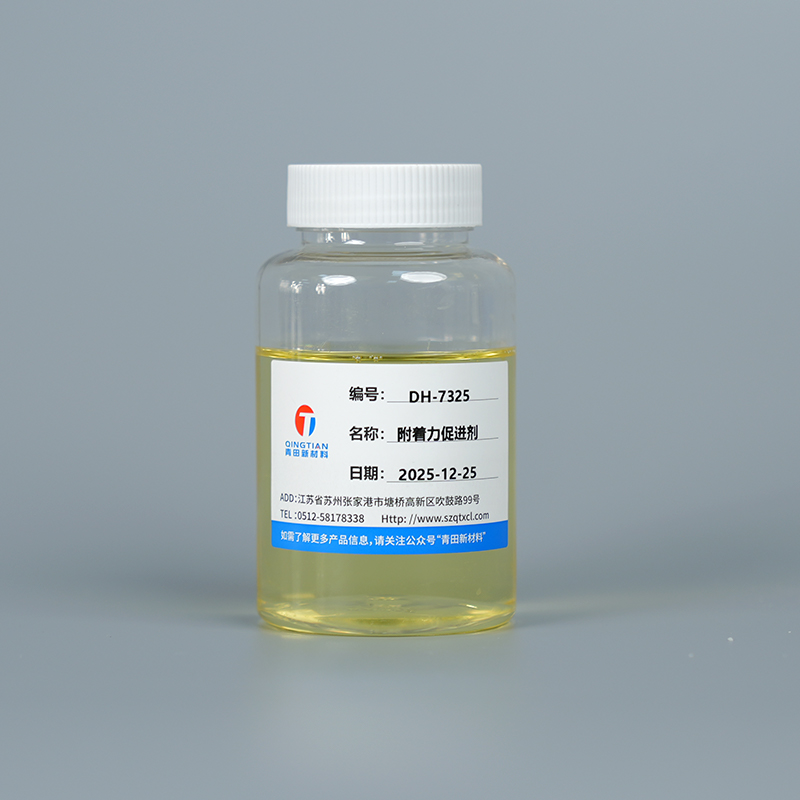
ADP adhesion additive can improve film adhesion on metal substrates such as aluminium, zinc, stainless steel and electroplated surfaces. Besides adhesion, it can improve film extensibility and impact resistance, help lower the baking temperature and improve solvent-rub resistance.
In an actual formulation, ADP can be used as one adhesion adjustment option according to coating type, metal substrate and baking process. If the aim is to lower baking temperature, also examine resin curing conditions and final film performance rather than judging only from the additive level.
Product name ADP adhesion additive
Appearance Clear transparent liquid
Solid content 80% ± 2
Density 1.08–1.10 g/cm³
Acid value 55–60 mg KOH/g
Viscosity 15–30 (Gardner tube, 25°C)
Solvent Isobutanol
Suggested addition 0.5%–1.5% of total coating
Set a blank control in the existing formulation first, then run small-scale trials at different addition ratios. Test cross-hatch adhesion, bending or impact performance, and solvent-rub resistance, and record baking temperature and time. Verify each metal substrate separately, so that results from one substrate are not applied directly to other materials.
Frequently Asked Questions
Is a dry film proof of good adhesion?
No. The bond between coating and substrate and the mechanical properties of the film also need attention.
Which substrates can ADP be used on?
It can improve film adhesion on aluminium, zinc, stainless steel and electroplated surfaces.
What is the suggested addition of ADP?
0.5%–1.5% of the total coating, set with small-scale trials against a blank control rather than a single fixed ratio.
Can results from one metal be applied to another?
No. Verify each metal substrate separately.
Summary
Adhesion problems in metal coating often relate to substrate surface state, resin system, film extensibility and baking conditions. Simply raising film hardness or repeatedly adjusting baking temperature does not necessarily solve every problem.
When adhesion on aluminium, zinc, stainless steel or plated surfaces is unsatisfactory, first check pretreatment and film-forming process, then evaluate an adhesion additive for the actual need. ADP can improve film adhesion on metal substrates while taking care of extensibility, impact resistance and solvent-rub resistance. The actual effect should be judged by the real formulation and test results.