русский
 Español
 Français
Industry News
Metal Baking Coatings · Aluminium · Zinc · Stainless · DH-7200
Metal baking coating looks like simply bonding the film to the metal surface, but the factors that need to be balanced in actual formulation are quite numerous. Aluminium, zinc, stainless steel, and electroplated surfaces have different surface characteristics. The same coating formulation after switching to a different substrate may also show changed film adhesion performance. At the same time, baking coatings need to go through heating cure. Therefore, for metal baking coatings, in addition to resin and crosslinker matching, adhesion promoter additives can also serve as one direction for formulation adjustment.
Different Metal Substrates — Large Differences in Adhesion Performance
Aluminium, zinc, stainless steel, and electroplated surfaces have different surface properties. One formulation that performs well on ordinary metal sheet may also need re-adjustment after switching substrate.
Good Initial Adhesion, but Changes in Subsequent Testing
Some films test normally for adhesion right after baking, but after wipe, water immersion, or other environmental testing, adhesion state changes — indicating the interface bonding and film structure need further observation.
Baking Conditions Create Production Efficiency Trade-Offs
Some baking coatings need relatively high temperature to reach the expected cure state. If the formulation has high temperature dependence, longer heating time or higher baking temperature is needed in production — adjustment of baking conditions and film formation state is therefore a consideration.
Film Hardness Increase May Change Flexibility
Metal workpieces undergo a certain degree of deformation during processing, bending, or impact. If the film is too hard and brittle, adhesion performance may not be maintained long-term, requiring hardness, elongation, and adhesion to be adjusted together for the actual application.
Why Simply Increasing Resin Is Not Always the Right Approach
When baking coating adhesion problems appear, adjusting resin proportion is a common thought. But film adhesion involves not only the amount of film-forming material — it also relates to resin structure, substrate surface state, and the interfacial bonding between film and metal. Simply increasing resin quantity may simultaneously bring changes in viscosity, cure speed, hardness, and workability without necessarily providing targeted adjustment to interfacial bonding.
Therefore, after the resin system is substantially confirmed, it is worth further approaching from adhesion promoter additives — changing the bonding state between the coating film and the metal substrate through small-quantity addition. For baking coating systems, it is also possible to simultaneously observe the influence of the additive on baking temperature, film flexibility, and wipe resistance.
DH-7200: Modified Polyester Adhesion Promoter for Metal Baking Systems
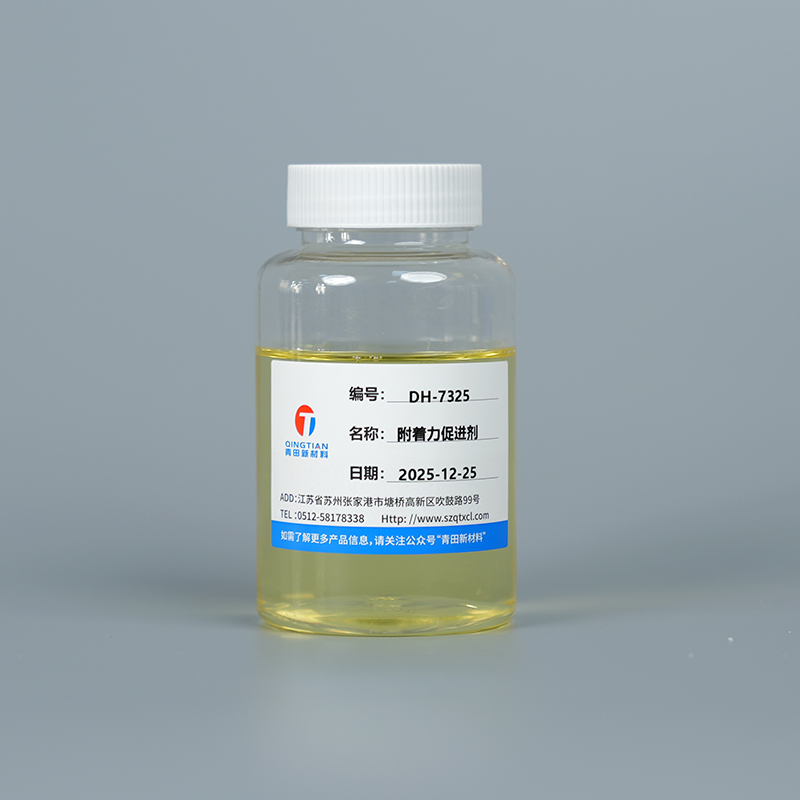
DH-7200 is a modified polyester adhesion promoter, primarily used in baking coating systems, suitable for formulation adjustment on metal substrates including aluminium, zinc, stainless steel, and electroplated surfaces. From an application perspective, it can be evaluated across three aspects: metal interfacial bonding, overall film performance, and baking conditions.
On metal substrates, DH-7200 can be used to adjust the bonding state between the film and substrate — for metal surfaces where conventional formulation adhesion performance is not ideal, it can serve as one direction for formulation optimisation. The product can also improve film elongation and impact resistance performance. For metal workpieces that need to undergo bending, stamping, or mechanical processing, this warrants testing combined with the actual process. Reference addition: 0.5%–1.5% of total formulation weight.
Step 1
Different Substrate Testing
Select aluminium, zinc, stainless steel, and electroplated board respectively. Compare adhesion before and after addition.
Step 2
Baking Condition Gradient Testing
Set different baking temperatures and times. Observe film hardness, adhesion, and appearance changes.
Step 3
Add Wipe Resistance Testing
Observe film state through different wipe counts. Determine the influence of the additive on film bonding.
Step 4
Observe Mechanical Performance
Combine bending and impact testing to judge whether adhesion improvement is consistent with film flexibility being maintained in an appropriate range.
Metal baking coating adhesion problems often involve multiple factors: substrate surface, resin structure, film state, and baking conditions. Especially on aluminium, zinc, stainless steel, and electroplated substrates, the same formulation may show different adhesion performance. Therefore, when adjusting the formulation, it is not possible to rely only on increasing resin or raising baking temperature. DH-7200 can be used as an adhesion promoter in baking coating systems, providing adjustment from metal interfacial bonding, film elongation, and wipe resistance performance directions.
Frequently Asked Questions
Why does baking coating adhesion on stainless steel tend to be more difficult than on mild steel or aluminium?
Stainless steel has a dense, stable chromium oxide passive layer on its surface that is chemically inert and has very low surface energy compared to bare metal. This passive layer is resistant to mechanical and chemical activation, providing fewer bonding sites for organic coating systems. Unlike mild steel where surface roughening and chemical pre-treatment can reliably increase surface energy and reactivity, stainless steel surface preparation options are more limited — making the contribution of adhesion promoters with specific reactivity for oxide surfaces more valuable for stainless steel applications.
Can DH-7200 also improve the adhesion of electroplated surfaces — which often fail adhesion testing despite looking clean?
Yes — electroplated surfaces, particularly nickel and chrome plating, present adhesion challenges similar to stainless steel: chemically smooth, low-porosity surfaces with limited reactive bonding sites for organic coatings. DH-7200's modified polyester chemistry is designed to interact with metal oxide and metallic surfaces, making it applicable for electroplated substrates where standard coatings show poor adhesion despite adequate surface cleaning. A gradient dosage trial on the specific plating type is recommended to confirm the optimal addition level.